Designing AI-Assisted Learning for Evidence-Grounded Academic Self-Efficacy: A Technical Framework for Higher Education
Keywords:
generative AI, academic self-efficacy, learning design, AI-assisted learning, higher educationAbstract
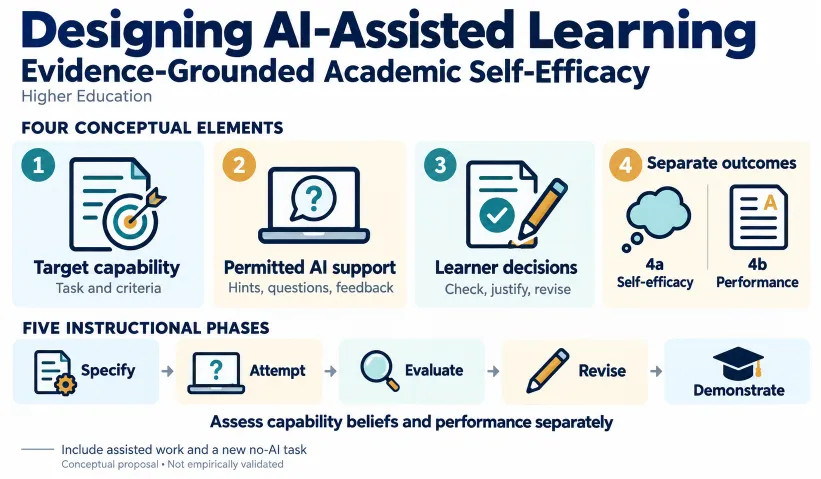
Generative AI can provide rapid explanations and feedback, yet successful work completed with AI does not by itself establish students’ academic self-efficacy or independent capability. This technical article develops a learning design and assessment framework from self-efficacy theory and selected higher education studies. Evidence from writing and programming indicates potential gains in task-specific self-efficacy, while comparisons of AI and instructor assistance show that performance and self-efficacy need not move together. The proposed framework links task conditions, the degree of AI assistance, learner decisions, and learners’ interpretations of the resulting performance experiences. It translates these relationships into a five-phase sequence: specify the target capability and permitted AI assistance; elicit a capability rating and an initial response without AI; require students to evaluate AI suggestions against task criteria; require them to revise and justify their decisions; and assess self-efficacy and performance separately on a comparable task completed without AI. A worked academic writing example identifies artifacts that instructors can collect without treating AI-produced text as proof of learning. The framework is a design proposal rather than an empirically validated intervention. Future tests should compare levels of assistance, examine the accuracy of capability judgments, and follow learning across new tasks. The framework asks instructors and researchers to specify the target capability, the permitted AI assistance, and the evidence of learner decisions before interpreting students’ self-efficacy.
Downloads
Downloads
Published
Issue
Section
License
Copyright (c) 2026 Journal of Innovative Learning

This work is licensed under a Creative Commons Attribution-NonCommercial-NoDerivatives 4.0 International License.