Development of a Situation Problem-Based Learning Model to Promote Grade 8 Students’ Critical Thinking in a Human Body Systems Unit
Development of a Situation Problem-Based Learning Model
Keywords:
Situation-based learning, problem-based learning, learning achievement, critical thinking, human body systemsAbstract
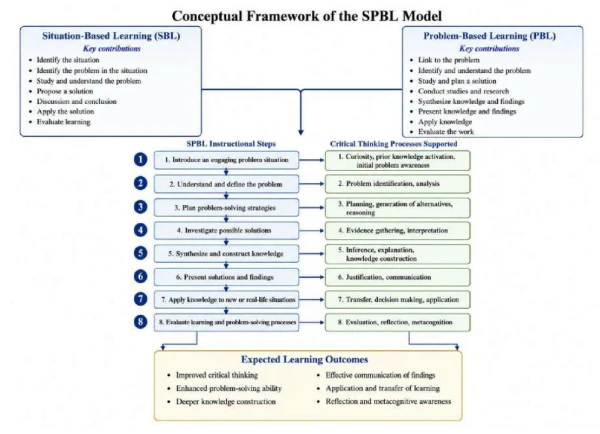
This study aimed to develop a Situation Problem-Based Learning (SPBL) model and examine its effects on Grade 8 students’ learning achievement and critical thinking in a human body systems unit. The SPBL model was synthesized from situation-based learning and problem-based learning. The study employed a model development process and a one-group pretest-posttest design. The participants were 45 Grade 8 students at Wichianmatu School, Trang Province, Thailand. The research instruments included an SPBL model evaluation form, a learning achievement test, and a critical thinking test. The content validity of the SPBL model was evaluated by a panel of experts using the Index of Item-Objective Congruence (IOC), with IOC values exceeding the acceptable criterion of .60. Students’ learning achievement scores before and after learning through the SPBL model were analyzed using a paired-samples t test, whereas students’ critical thinking scores after learning were compared with the 70% criterion using a one-sample t test. The results showed that students’ post-test learning achievement scores were significantly higher than their pre-test scores, t(44) = 30.03, p < .001. Students’ critical thinking score after learning was slightly higher than the 70% criterion, t(44) = 2.03, p = .049. These findings suggest that the SPBL model may support science learning and provide opportunities for students to engage in critical thinking processes. Implications for science teaching and instructional model development are discussed.
Downloads
Downloads
Published
Issue
Section
License
Copyright (c) 2026 Journal of Innovative Learning

This work is licensed under a Creative Commons Attribution-NonCommercial-NoDerivatives 4.0 International License.